Smart JSA Bridge
JSA Risk Assessment Preview: Formwork Assembly and Stripping Operations
7/22/2026
0. JSA Risk Assessment Preview: Formwork Assembly and Stripping Operations
| Item | Job Step | Hazard Factors | Risk Control Measures | Probability | Severity | Risk Level |
|---|---|---|---|---|---|---|
| 1 | Formwork Material Delivery, Unloading, and Yard Stacking | • Rigging failure or bundle slippage during crane unloading causing gang form/plywood drops and struck-by injuries • Ground settlement or missing timber dunnage causing formwork stack collapse or roll-off | • Inspect dedicated lifting clamps and dual-wire rigging examined under LOLER; establish exclusion zones in unloading areas • Stack formwork on level, compacted ground with timber dunnage and end-stoppers; adhere to stacking height limits | 2 | 3 | 6 |
| 2 | Wall and Column Formwork (Euroform/Alform) Assembly and Plumbing | • Fall hazards from unguarded edges or working platforms during formwork placement without personal fall protection • Sudden wind gusts or eccentric loading causing unbraced vertical wall forms to overturn | • Utilize integrated working platforms or erect compliant scaffolds under Work at Height Regulations; mandate 100% tie-off • Immediately secure pipe props, turnbuckles, and diagonal bracing upon standing forms per BS 5975 temporary works design | 2 | 3 | 6 |
| 3 | Slab Formwork Decking and Falsework (Falsework System/Prop) Installation | • Falsework system buckling or structural collapse caused by missing horizontal node bracing or localized overloading • Falls through deck openings or unguarded perimeter edges during primary and secondary beam placement | • Use dedicated height-adjustment pins and base plates for props; install horizontal L-bracing every 2m height • Pre-install safety netting compliant with BS EN 1263-1; mandate continuous tie-off to overhead lifelines during decking | 2 | 3 | 6 |
| 4 | Concrete Pour Monitoring, Lateral Pressure Surveillance, and Falsework Inspection | • Formwork blowout or falsework collapse due to rapid concrete placement or excessive hydrostatic lateral pressure • Form tie or flat tie rupture causing high-velocity flying debris and structural deformation | • Enforce controlled pour rates and prohibit uneven dumping; assign dedicated watchmen to continuously inspect falsework • Verify form tie spacing against temporary works design calculations; perform pre-pour dual checks on locking hardware | 2 | 3 | 6 |
| 5 | Slab and Wall Formwork Stripping (Striking) Operations | • Premature falsework removal before concrete reaches required characteristic cube strength causing catastrophic slab collapse • Stripped formwork panels dropping from elevated decks or striking workers during manual pry-bar striking | • Verify field-cured cube compressive test results and obtain Temporary Works Coordinator (TWC) sign-off prior to striking • Establish 2-level drop-zone exclusion areas below with spotters; use mechanical lowering devices for form panels | 2 | 3 | 6 |
| 6 | Stripped Material Removal, Hardware Sorting, and Housekeeping | • Puncture wounds and trip hazards from protruding form ties, anchor bolts, and scattered hardware • Struck-by or fall hazards caused by material accumulation near unprotected deck perimeters | • Remove protruding ties and hardware immediately upon striking; collect in designated bins; mandate steel-midsole boots • Set back stacked materials at least 1.5m from deck edges; bundle and secure panels before crane hoisting | 1 | 2 | 2 |
1. On-Site Incident & Hazard Analysis
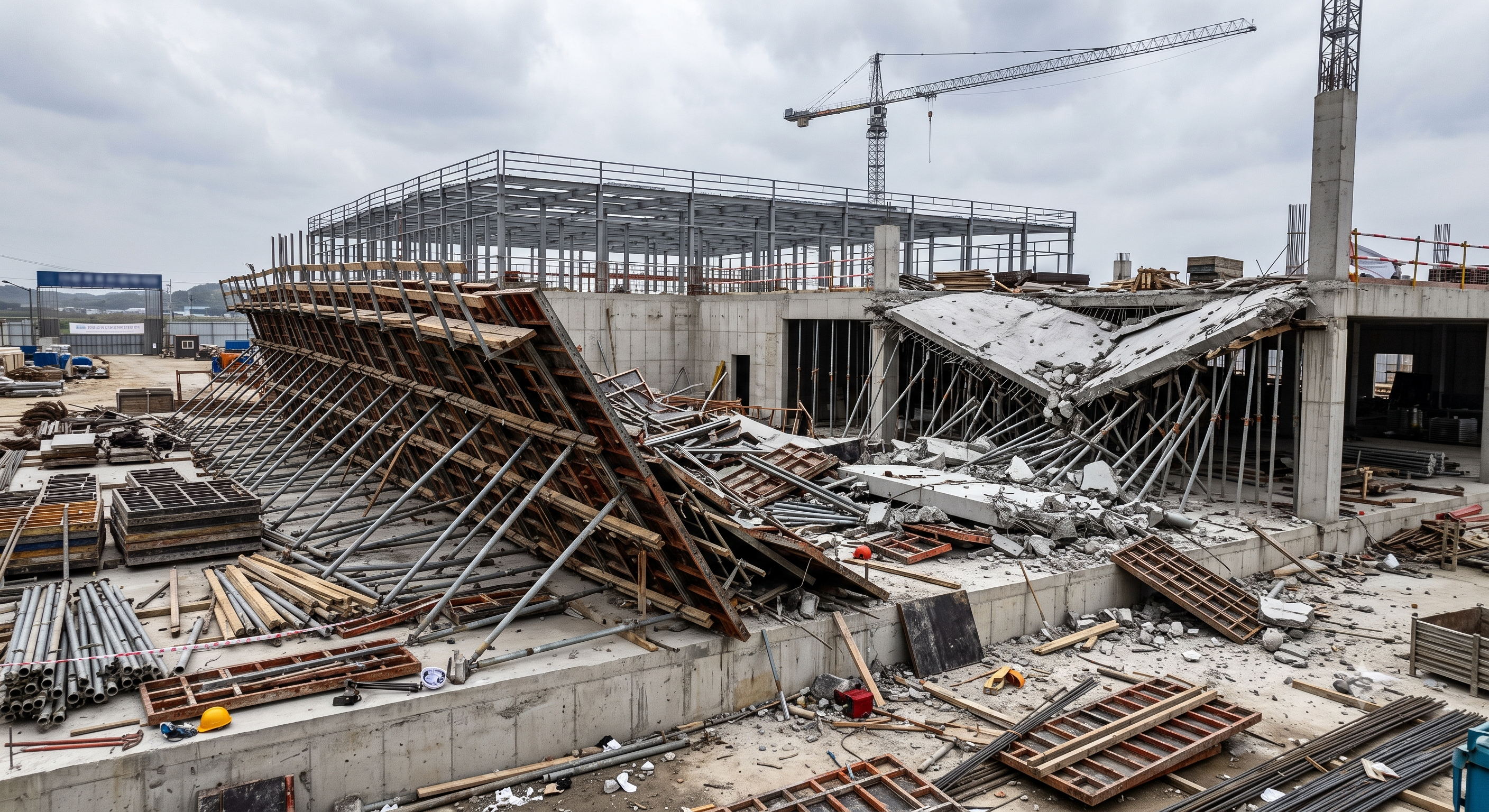
A. Near-Miss Case: Wall Formwork Overturning and Premature Slab Stripping Collapse
At a multi-story commercial building project in Yorkshire, a formwork crew was assembling a large gang-form wall assembly on an upper deck. To accelerate the pour schedule, the crew erected the heavy vertical panels without installing temporary diagonal pipe props or guy turnbuckles, intending to secure them after placing the top alignment ties.
Before the ties could be secured, a sudden wind gust swept across the open deck. Subjected to lateral wind loads and the eccentric weight of workers climbing the frame, the unbraced wall form lost equilibrium and overturned onto the working deck. Two carpenters fell with the panel structure, while a worker on the lower deck was narrowly missed by falling alignment hardware. In a separate incident at the same site, slab falsework props were prematurely struck before field-cured concrete cubes reached the required characteristic strength, causing a localized shear collapse of the newly poured slab deck. Ensuing Health and Safety Executive (HSE) investigations cited serious failures under the Construction (Design and Management) Regulations 2015 (CDM 2015) and Work at Height Regulations 2005.
B. Structural, Mechanical, and Regulatory Hazard Mechanisms
Formwork and falsework systems represent temporary works operating at peak structural instability before and during concrete placement. Unbraced vertical wall forms exhibit high slenderness ratios, making them extremely susceptible to lateral overturning forces induced by wind pressure, impact loads, or eccentric worker movement. Without diagonal guy props or turnbuckles, minimal lateral force generates an overturning moment exceeding the base resistance.
During concrete placement, wet concrete exerts significant hydrostatic lateral pressure against formwork faces. If placement rates exceed design limits or internal vibrators are over-utilized, lateral pressure spikes dramatically, leading to form tie rupture and explosive formwork blowouts. During striking operations, falsework supports the full dead weight of the green concrete slab. Removing props prior to verified compressive strength development causes sudden flexural and punching shear failure of the concrete structure. Rigorous compliance with CDM 2015, BS 5975 (Code of practice for temporary works procedures), and mandatory cube testing are essential to prevent structural failures.
🚨 UK Statutory Regulations & Safety Standards (HSE, CDM 2015 & BS 5975)
Construction (Design and Management) Regulations 2015 (CDM 2015): Mandates that all temporary works, including formwork and falsework bracing, must be designed, inspected, and formally approved by a appointed Temporary Works Coordinator (TWC).
Work at Height Regulations 2005: Requires effective guardrail edge protection, fully boarded working platforms, and personal fall protection systems whenever personnel work where a fall liable to cause injury could occur.
BS 5975:2019 (Code of practice for temporary works procedures and the permissible stress design of falsework): Governs the management, design, erection, loading, and safe striking protocols for temporary support structures.
Lifting Operations and Lifting Equipment Regulations 1998 (LOLER): Requires all formwork lifting clamps, slings, and spreader beams to undergo thorough examination and pre-use checks before hoisting.
2. Standard Data Entry Guide for Smart JSA Bridge
To ensure the Smart JSA Bridge platform generates safety control measures fully compliant with UK HSE guidelines and BS 5975 standards, enter the following standardized job steps into the system:
[Step 1] Formwork Material Delivery, Unloading, and Yard Stacking
Detailed Description: Inspect dedicated lifting clamps and rigging under LOLER; establish unloading exclusion zones; stack formwork panels on level ground with timber dunnage.
[Step 2] Wall and Column Formwork (Euroform/Alform) Assembly and Plumbing
Detailed Description: Erect compliant scaffolds under Work at Height Regulations; install diagonal pipe props and turnbuckles immediately upon standing wall forms.
[Step 3] Slab Formwork Decking and Falsework (Falsework System/Prop) Installation
Detailed Description: Position props per temporary works design drawings; install horizontal bracing every 2m; pre-install safety netting and horizontal lifelines prior to deck placement.
[Step 4] Concrete Pour Monitoring, Lateral Pressure Surveillance, and Falsework Inspection
Detailed Description: Control concrete pour rates; assign dedicated watchmen to monitor falsework during pour; perform dual checks on form ties and wedge pins.
[Step 5] Slab and Wall Formwork Stripping (Striking) Operations
Detailed Description: Verify field-cured cube test results before striking; obtain TWC sign-off; establish drop-zone exclusion barriers below striking decks.
[Step 6] Stripped Material Removal, Hardware Sorting, and Housekeeping
Detailed Description: Remove protruding ties and hardware immediately; set back stacked materials 1.5m from edges; mandate steel-midsole safety footwear.
3. Recommended Final JSA Document (Database Sample)
Below is the final JSA document generated based on automated system recommendations and adapted for UK civil engineering and building conditions:
| Item | Job Step | Hazard Factors | Risk Control Measures | Probability | Severity | Risk Level |
|---|---|---|---|---|---|---|
| 1 | Formwork Material Delivery, Unloading, and Yard Stacking | • Rigging failure or bundle slippage during crane unloading causing gang form/plywood drops and struck-by injuries • Ground settlement or missing timber dunnage causing formwork stack collapse or roll-off | • Inspect dedicated lifting clamps and dual-wire rigging examined under LOLER; establish exclusion zones in unloading areas • Stack formwork on level, compacted ground with timber dunnage and end-stoppers; adhere to stacking height limits | 2 | 3 | 6 |
| 2 | Wall and Column Formwork (Euroform/Alform) Assembly and Plumbing | • Fall hazards from unguarded edges or working platforms during formwork placement without personal fall protection • Sudden wind gusts or eccentric loading causing unbraced vertical wall forms to overturn | • Utilize integrated working platforms or erect compliant scaffolds under Work at Height Regulations; mandate 100% tie-off • Immediately secure pipe props, turnbuckles, and diagonal bracing upon standing forms per BS 5975 temporary works design | 2 | 3 | 6 |
| 3 | Slab Formwork Decking and Falsework (Falsework System/Prop) Installation | • Falsework system buckling or structural collapse caused by missing horizontal node bracing or localized overloading • Falls through deck openings or unguarded perimeter edges during primary and secondary beam placement | • Use dedicated height-adjustment pins and base plates for props; install horizontal L-bracing every 2m height • Pre-install safety netting compliant with BS EN 1263-1; mandate continuous tie-off to overhead lifelines during decking | 2 | 3 | 6 |
| 4 | Concrete Pour Monitoring, Lateral Pressure Surveillance, and Falsework Inspection | • Formwork blowout or falsework collapse due to rapid concrete placement or excessive hydrostatic lateral pressure • Form tie or flat tie rupture causing high-velocity flying debris and structural deformation | • Enforce controlled pour rates and prohibit uneven dumping; assign dedicated watchmen to continuously inspect falsework • Verify form tie spacing against temporary works design calculations; perform pre-pour dual checks on locking hardware | 2 | 3 | 6 |
| 5 | Slab and Wall Formwork Stripping (Striking) Operations | • Premature falsework removal before concrete reaches required characteristic cube strength causing catastrophic slab collapse • Stripped formwork panels dropping from elevated decks or striking workers during manual pry-bar striking | • Verify field-cured cube compressive test results and obtain Temporary Works Coordinator (TWC) sign-off prior to striking • Establish 2-level drop-zone exclusion areas below with spotters; use mechanical lowering devices for form panels | 2 | 3 | 6 |
| 6 | Stripped Material Removal, Hardware Sorting, and Housekeeping | • Puncture wounds and trip hazards from protruding form ties, anchor bolts, and scattered hardware • Struck-by or fall hazards caused by material accumulation near unprotected deck perimeters | • Remove protruding ties and hardware immediately upon striking; collect in designated bins; mandate steel-midsole boots • Set back stacked materials at least 1.5m from deck edges; bundle and secure panels before crane hoisting | 1 | 2 | 2 |
4. JSA Engineering Mechanism for Formwork Operations: Overturning Prevention and Concrete Pressure Control
Formwork assembly, concrete pour surveillance, and striking operations demand strict engineering controls and compliance with UK statutory regulations to prevent formwork blowouts, structural collapses, and fatal fall injuries. Vague instructions like "be careful during formwork assembly" or "check falsework" fail to satisfy HSE enforcement standards or CDM 2015 compliance audits.
Smart JSA Bridge leverages an automated risk analysis algorithm calibrated against CDM 2015, Work at Height Regulations, BS 5975 temporary works standards, and LOLER to deliver actionable, site-specific risk control measures.
By inputting 6 structured job steps, the algorithm calculates technical parameters—including diagonal guy prop bracing requirements for wall forms, horizontal falsework node tie-in intervals, lateral pour-rate limits, and concrete cube compressive strength thresholds for safe striking.
Site Managers, Temporary Works Coordinators (TWC), and Health & Safety Advisors can customize these parameters with a single click to match specific formwork designs and structural drawings.
Optimize your safety documentation workflow while ensuring total UK statutory compliance for temporary works and concrete construction operations. Generate your customized risk assessment today.
👉 Enter job steps on Smart JSA Bridge and generate your custom JSA (smartjsabridge.com)
Smart JSA Bridge
JSA Risk Assessment Preview: Formwork Assembly and Stripping Operations
7/22/2026
0. JSA Risk Assessment Preview: Formwork Assembly and Stripping Operations
| Item | Job Step | Hazard Factors | Risk Control Measures | Probability | Severity | Risk Level |
|---|---|---|---|---|---|---|
| 1 | Formwork Material Delivery, Unloading, and Yard Stacking | • Rigging failure or bundle slippage during crane unloading causing gang form/plywood drops and struck-by injuries • Ground settlement or missing timber dunnage causing formwork stack collapse or roll-off | • Inspect dedicated lifting clamps and dual-wire rigging examined under LOLER; establish exclusion zones in unloading areas • Stack formwork on level, compacted ground with timber dunnage and end-stoppers; adhere to stacking height limits | 2 | 3 | 6 |
| 2 | Wall and Column Formwork (Euroform/Alform) Assembly and Plumbing | • Fall hazards from unguarded edges or working platforms during formwork placement without personal fall protection • Sudden wind gusts or eccentric loading causing unbraced vertical wall forms to overturn | • Utilize integrated working platforms or erect compliant scaffolds under Work at Height Regulations; mandate 100% tie-off • Immediately secure pipe props, turnbuckles, and diagonal bracing upon standing forms per BS 5975 temporary works design | 2 | 3 | 6 |
| 3 | Slab Formwork Decking and Falsework (Falsework System/Prop) Installation | • Falsework system buckling or structural collapse caused by missing horizontal node bracing or localized overloading • Falls through deck openings or unguarded perimeter edges during primary and secondary beam placement | • Use dedicated height-adjustment pins and base plates for props; install horizontal L-bracing every 2m height • Pre-install safety netting compliant with BS EN 1263-1; mandate continuous tie-off to overhead lifelines during decking | 2 | 3 | 6 |
| 4 | Concrete Pour Monitoring, Lateral Pressure Surveillance, and Falsework Inspection | • Formwork blowout or falsework collapse due to rapid concrete placement or excessive hydrostatic lateral pressure • Form tie or flat tie rupture causing high-velocity flying debris and structural deformation | • Enforce controlled pour rates and prohibit uneven dumping; assign dedicated watchmen to continuously inspect falsework • Verify form tie spacing against temporary works design calculations; perform pre-pour dual checks on locking hardware | 2 | 3 | 6 |
| 5 | Slab and Wall Formwork Stripping (Striking) Operations | • Premature falsework removal before concrete reaches required characteristic cube strength causing catastrophic slab collapse • Stripped formwork panels dropping from elevated decks or striking workers during manual pry-bar striking | • Verify field-cured cube compressive test results and obtain Temporary Works Coordinator (TWC) sign-off prior to striking • Establish 2-level drop-zone exclusion areas below with spotters; use mechanical lowering devices for form panels | 2 | 3 | 6 |
| 6 | Stripped Material Removal, Hardware Sorting, and Housekeeping | • Puncture wounds and trip hazards from protruding form ties, anchor bolts, and scattered hardware • Struck-by or fall hazards caused by material accumulation near unprotected deck perimeters | • Remove protruding ties and hardware immediately upon striking; collect in designated bins; mandate steel-midsole boots • Set back stacked materials at least 1.5m from deck edges; bundle and secure panels before crane hoisting | 1 | 2 | 2 |
1. On-Site Incident & Hazard Analysis
A. Near-Miss Case: Wall Formwork Overturning and Premature Slab Stripping Collapse
At a multi-story commercial building project in Yorkshire, a formwork crew was assembling a large gang-form wall assembly on an upper deck. To accelerate the pour schedule, the crew erected the heavy vertical panels without installing temporary diagonal pipe props or guy turnbuckles, intending to secure them after placing the top alignment ties.
Before the ties could be secured, a sudden wind gust swept across the open deck. Subjected to lateral wind loads and the eccentric weight of workers climbing the frame, the unbraced wall form lost equilibrium and overturned onto the working deck. Two carpenters fell with the panel structure, while a worker on the lower deck was narrowly missed by falling alignment hardware. In a separate incident at the same site, slab falsework props were prematurely struck before field-cured concrete cubes reached the required characteristic strength, causing a localized shear collapse of the newly poured slab deck. Ensuing Health and Safety Executive (HSE) investigations cited serious failures under the Construction (Design and Management) Regulations 2015 (CDM 2015) and Work at Height Regulations 2005.
B. Structural, Mechanical, and Regulatory Hazard Mechanisms
Formwork and falsework systems represent temporary works operating at peak structural instability before and during concrete placement. Unbraced vertical wall forms exhibit high slenderness ratios, making them extremely susceptible to lateral overturning forces induced by wind pressure, impact loads, or eccentric worker movement. Without diagonal guy props or turnbuckles, minimal lateral force generates an overturning moment exceeding the base resistance.
During concrete placement, wet concrete exerts significant hydrostatic lateral pressure against formwork faces. If placement rates exceed design limits or internal vibrators are over-utilized, lateral pressure spikes dramatically, leading to form tie rupture and explosive formwork blowouts. During striking operations, falsework supports the full dead weight of the green concrete slab. Removing props prior to verified compressive strength development causes sudden flexural and punching shear failure of the concrete structure. Rigorous compliance with CDM 2015, BS 5975 (Code of practice for temporary works procedures), and mandatory cube testing are essential to prevent structural failures.
🚨 UK Statutory Regulations & Safety Standards (HSE, CDM 2015 & BS 5975)
Construction (Design and Management) Regulations 2015 (CDM 2015): Mandates that all temporary works, including formwork and falsework bracing, must be designed, inspected, and formally approved by a appointed Temporary Works Coordinator (TWC).
Work at Height Regulations 2005: Requires effective guardrail edge protection, fully boarded working platforms, and personal fall protection systems whenever personnel work where a fall liable to cause injury could occur.
BS 5975:2019 (Code of practice for temporary works procedures and the permissible stress design of falsework): Governs the management, design, erection, loading, and safe striking protocols for temporary support structures.
Lifting Operations and Lifting Equipment Regulations 1998 (LOLER): Requires all formwork lifting clamps, slings, and spreader beams to undergo thorough examination and pre-use checks before hoisting.
2. Standard Data Entry Guide for Smart JSA Bridge
To ensure the Smart JSA Bridge platform generates safety control measures fully compliant with UK HSE guidelines and BS 5975 standards, enter the following standardized job steps into the system:
[Step 1] Formwork Material Delivery, Unloading, and Yard Stacking
Detailed Description: Inspect dedicated lifting clamps and rigging under LOLER; establish unloading exclusion zones; stack formwork panels on level ground with timber dunnage.
[Step 2] Wall and Column Formwork (Euroform/Alform) Assembly and Plumbing
Detailed Description: Erect compliant scaffolds under Work at Height Regulations; install diagonal pipe props and turnbuckles immediately upon standing wall forms.
[Step 3] Slab Formwork Decking and Falsework (Falsework System/Prop) Installation
Detailed Description: Position props per temporary works design drawings; install horizontal bracing every 2m; pre-install safety netting and horizontal lifelines prior to deck placement.
[Step 4] Concrete Pour Monitoring, Lateral Pressure Surveillance, and Falsework Inspection
Detailed Description: Control concrete pour rates; assign dedicated watchmen to monitor falsework during pour; perform dual checks on form ties and wedge pins.
[Step 5] Slab and Wall Formwork Stripping (Striking) Operations
Detailed Description: Verify field-cured cube test results before striking; obtain TWC sign-off; establish drop-zone exclusion barriers below striking decks.
[Step 6] Stripped Material Removal, Hardware Sorting, and Housekeeping
Detailed Description: Remove protruding ties and hardware immediately; set back stacked materials 1.5m from edges; mandate steel-midsole safety footwear.
3. Recommended Final JSA Document (Database Sample)
Below is the final JSA document generated based on automated system recommendations and adapted for UK civil engineering and building conditions:
| Item | Job Step | Hazard Factors | Risk Control Measures | Probability | Severity | Risk Level |
|---|---|---|---|---|---|---|
| 1 | Formwork Material Delivery, Unloading, and Yard Stacking | • Rigging failure or bundle slippage during crane unloading causing gang form/plywood drops and struck-by injuries • Ground settlement or missing timber dunnage causing formwork stack collapse or roll-off | • Inspect dedicated lifting clamps and dual-wire rigging examined under LOLER; establish exclusion zones in unloading areas • Stack formwork on level, compacted ground with timber dunnage and end-stoppers; adhere to stacking height limits | 2 | 3 | 6 |
| 2 | Wall and Column Formwork (Euroform/Alform) Assembly and Plumbing | • Fall hazards from unguarded edges or working platforms during formwork placement without personal fall protection • Sudden wind gusts or eccentric loading causing unbraced vertical wall forms to overturn | • Utilize integrated working platforms or erect compliant scaffolds under Work at Height Regulations; mandate 100% tie-off • Immediately secure pipe props, turnbuckles, and diagonal bracing upon standing forms per BS 5975 temporary works design | 2 | 3 | 6 |
| 3 | Slab Formwork Decking and Falsework (Falsework System/Prop) Installation | • Falsework system buckling or structural collapse caused by missing horizontal node bracing or localized overloading • Falls through deck openings or unguarded perimeter edges during primary and secondary beam placement | • Use dedicated height-adjustment pins and base plates for props; install horizontal L-bracing every 2m height • Pre-install safety netting compliant with BS EN 1263-1; mandate continuous tie-off to overhead lifelines during decking | 2 | 3 | 6 |
| 4 | Concrete Pour Monitoring, Lateral Pressure Surveillance, and Falsework Inspection | • Formwork blowout or falsework collapse due to rapid concrete placement or excessive hydrostatic lateral pressure • Form tie or flat tie rupture causing high-velocity flying debris and structural deformation | • Enforce controlled pour rates and prohibit uneven dumping; assign dedicated watchmen to continuously inspect falsework • Verify form tie spacing against temporary works design calculations; perform pre-pour dual checks on locking hardware | 2 | 3 | 6 |
| 5 | Slab and Wall Formwork Stripping (Striking) Operations | • Premature falsework removal before concrete reaches required characteristic cube strength causing catastrophic slab collapse • Stripped formwork panels dropping from elevated decks or striking workers during manual pry-bar striking | • Verify field-cured cube compressive test results and obtain Temporary Works Coordinator (TWC) sign-off prior to striking • Establish 2-level drop-zone exclusion areas below with spotters; use mechanical lowering devices for form panels | 2 | 3 | 6 |
| 6 | Stripped Material Removal, Hardware Sorting, and Housekeeping | • Puncture wounds and trip hazards from protruding form ties, anchor bolts, and scattered hardware • Struck-by or fall hazards caused by material accumulation near unprotected deck perimeters | • Remove protruding ties and hardware immediately upon striking; collect in designated bins; mandate steel-midsole boots • Set back stacked materials at least 1.5m from deck edges; bundle and secure panels before crane hoisting | 1 | 2 | 2 |
4. JSA Engineering Mechanism for Formwork Operations: Overturning Prevention and Concrete Pressure Control
Formwork assembly, concrete pour surveillance, and striking operations demand strict engineering controls and compliance with UK statutory regulations to prevent formwork blowouts, structural collapses, and fatal fall injuries. Vague instructions like "be careful during formwork assembly" or "check falsework" fail to satisfy HSE enforcement standards or CDM 2015 compliance audits.
Smart JSA Bridge leverages an automated risk analysis algorithm calibrated against CDM 2015, Work at Height Regulations, BS 5975 temporary works standards, and LOLER to deliver actionable, site-specific risk control measures.
By inputting 6 structured job steps, the algorithm calculates technical parameters—including diagonal guy prop bracing requirements for wall forms, horizontal falsework node tie-in intervals, lateral pour-rate limits, and concrete cube compressive strength thresholds for safe striking.
Site Managers, Temporary Works Coordinators (TWC), and Health & Safety Advisors can customize these parameters with a single click to match specific formwork designs and structural drawings.
Optimize your safety documentation workflow while ensuring total UK statutory compliance for temporary works and concrete construction operations. Generate your customized risk assessment today.
👉 Enter job steps on Smart JSA Bridge and generate your custom JSA (smartjsabridge.com)